Long-form responses
The narrative sections, with a source on every claim
Some buyer questions want prose: the approach, the methodology, why you and not the incumbent. This page is how those get written, who can change them, and what happens to a claim nobody has approved.
How a narrative answer gets written
Five steps. The fourth is the one that decides whether a long section is reviewable at all.
- 01
The question that wants prose
Not every question fits a cell. The approach, the methodology, why you and not the incumbent. Those are pulled out at intake and handled as narrative rather than squeezed into a field.
- 02
The deal, not just the library
The draft is written with what is known about this deal: the industry, what the buyer has asked already, which of your past wins look like this one.
- 03
A source on every claim
Each claim in the narrative carries the document it came from. A reader who wants to check the implementation timeline gets the plan it was drawn from, not a paragraph that sounds confident.
- 04
A named person can reject it
Every claim has an owner who can replace or remove it before the document leaves. Approval is per claim, not a sign-off on a finished essay nobody has time to re-read.
- 05
Out in the structure it arrived in
The response goes back in the format the buyer set, with the narrative and the cell answers consistent with each other because both came from the same approved content.
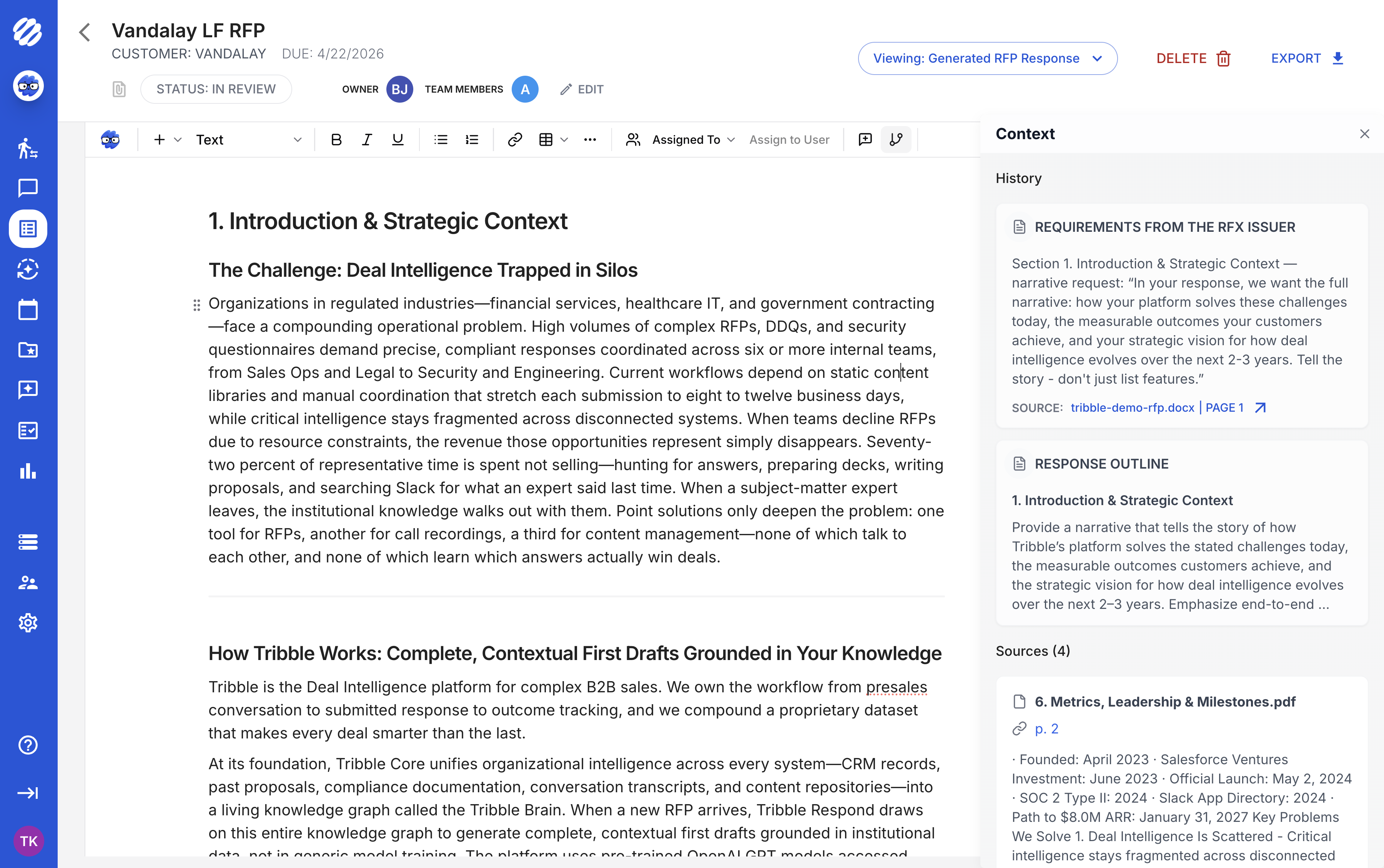
What makes a long section reviewable
Reviewing prose somebody else wrote is slower than writing it, unless you can tell which sentences to actually check.
Per-claim sourcing
Each claim names the document behind it, so review is checking a citation rather than judging a tone.
Per-claim ownership
A named person can replace or remove one sentence without the section going back to the start.
Deal context
Written with what is known about this buyer and the wins that look like this one, rather than from a generic library entry.
Consistent with the cells
The prose and the structured answers come from the same approved content, so one does not promise what the other denies.
Nothing unsourced is written
Where approved content does not cover a claim, it is routed to its owner instead of filled in.
Questions that come up on long-form work
The ones that come up on nearly every call.
What counts as a long-form response?
Any question that wants prose rather than a value. Approach and methodology, implementation plan, why you over the incumbent, references and case detail, transition and risk. In most RFPs these are a handful of questions that take a disproportionate share of the time.
How is this different from asking a chat assistant to write it?
A chat assistant writes fluently from whatever is in its context. This writes from content your team has approved, names the document behind each claim, and routes a claim nobody has approved to the person who owns it instead of filling the gap.
Can a reviewer change one claim without rewriting the section?
Yes. Approval is per claim rather than per document, so an owner can replace a single sentence and leave the rest, which is what makes reviewing a long section tractable.
Does the narrative stay consistent with the cell answers?
Both are drafted from the same approved content and checked against each other, so the prose does not promise something the structured answers contradict. That mismatch is one of the most common reasons a response gets questioned.
What does it do when there is no approved content for a claim?
It routes rather than writes. The claim goes to the owner with the context, and once they answer it the response is kept for next time.
Read next
Tribble Respond is the product this runs on, alongside RFPs, security questionnaires, DDQs and portal intake. RFP automation covers the structured half of the same response.
See it write one of your narrative sections
Thirty minutes, nothing to prepare. Bring the section that always takes longest, or we will use ours.